
Il Colombarone, restored 2012–2014 · The annex, restored 2025–2026
This place was handed down to me by my family, and I have always felt it to be a common good to look after: a corner of the Garda countryside that has remained almost untouched, just a few minutes from the centre of Bardolino.
Year after year I try to carry it into the future without betraying it: restoring the buildings with respect, giving shape back to the centuries-old olive trees, replanting the vineyards and leaving room for the nature that was here before us.
— Domenico Ferrari Barettoni
The past
A seventeenth-century farmhouse
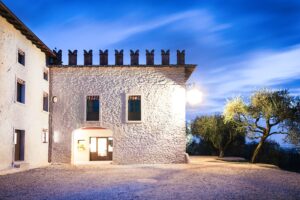
Il Colombarone, which in old documents and in dialect also appears as Colombarola or “Colombara”, is the farmhouse where the sharecroppers and some of the estate workers once lived, in the service of the main villa, Villa Ferrari. The original core probably dates back to the seventeenth century; a first addition was made in the early nineteenth century, the last in 1912.
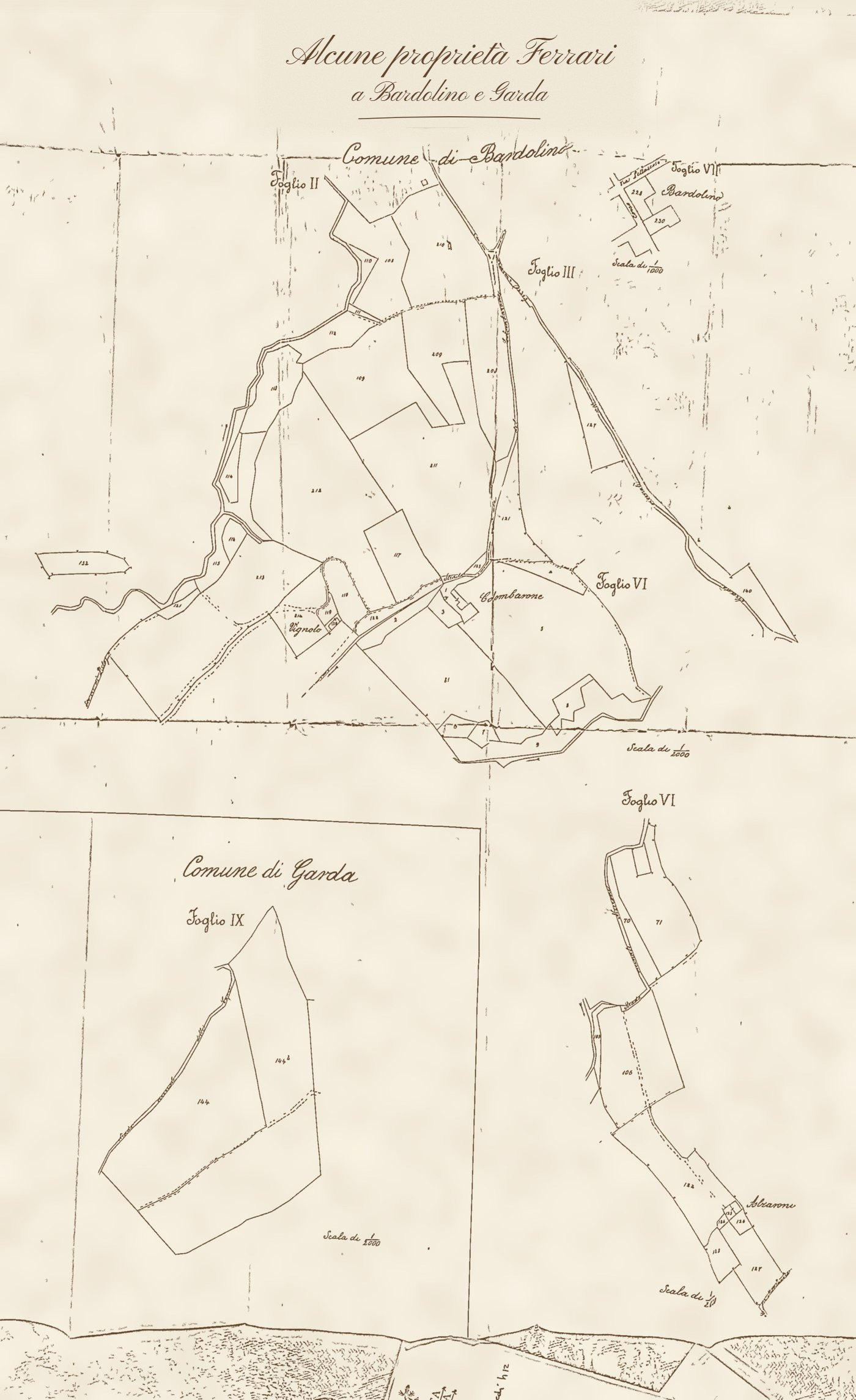
Some Ferrari properties in Bardolino and Garda, late nineteenth century: Il Colombarone and the house that is now our annex can both be recognised. Family archive.
The house stands on the first hills of Bardolino, gentle slopes shaped by the glaciers that, as they retreated, formed Lake Garda and its amphitheatre of moraine hills. A landscape of olive groves, pergola vineyards, meadows and woods, worked for centuries by sharecropping families, that still keeps its agricultural pattern today.
The restoration · 2012–2014
The project
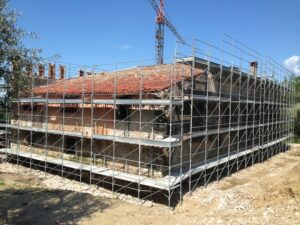
The restoration began with a first thought by the architect Giuseppe Tommasi, who died prematurely. The project was then developed and completed by the architect Damiano Zerman of Studio Athesis in Verona. The first ideas, drawings and planning applications date back to 2009; the actual building work, with local craftsmen, took place between 2012 and 2014, guided by a single principle: respect for the building and for the place.
An architect from Verona, he studied at the Politecnico di Milano and graduated from IUAV in Venice in 1973 with Carlo Scarpa as his supervisor, becoming his pupil and collaborator. Scarpa, one of the great masters of the twentieth century, transformed Castelvecchio in Verona into a museum (1956–1975), a work completed by Tommasi himself. He died prematurely in 2012: Il Colombarone still bears the imprint of his first thought.
Materials and craftsmen
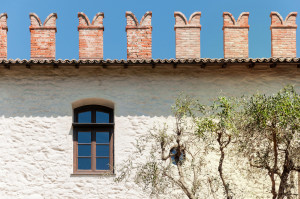
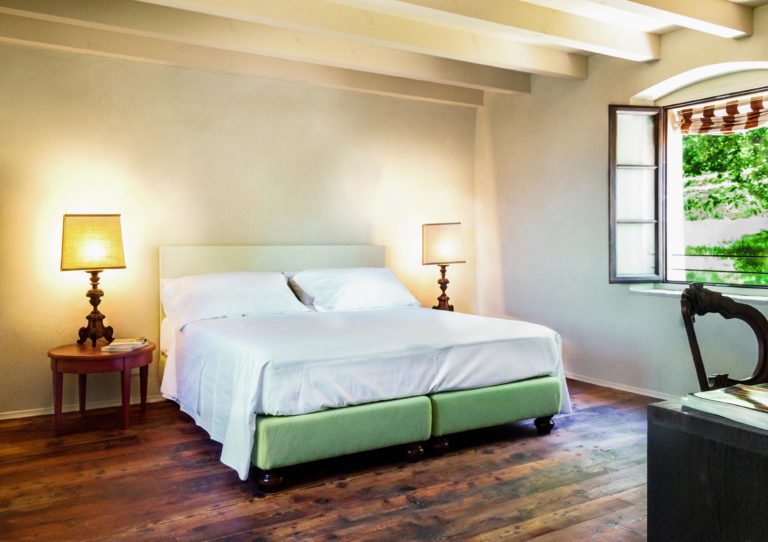
Behind the simplicity of the house lies a long work of research. Only natural, top-quality materials, worked by local craftsmen: reclaimed wooden boards for the suite floors, “spolvero” coloured cement and wine-red oxide in the common areas and bathrooms, lime paints with natural pigments and oxides on walls and ceilings. Nothing foreign to the building: the house has stayed simple, as it was born.
Breathable lime lets the old walls breathe and changes tone with the daylight; natural pigments and earths give it warm, never uniform colours. “Spolvero” cement is made by sprinkling coloured oxide onto still-fresh cement and smoothing it by hand: no two floors are alike. The windows, designed one by one, were made by local craftsmen. In the bathrooms, taps from the Roma series by Rubinetterie Stella.
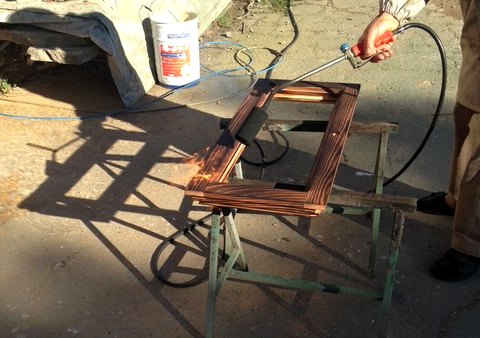
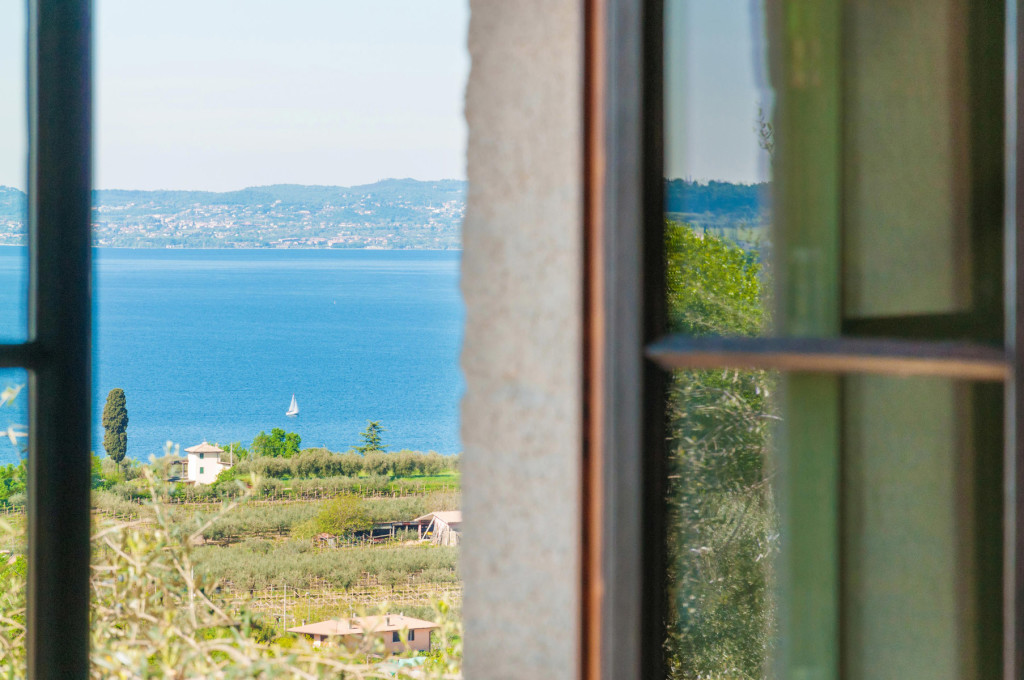
The brushed and burnt larch windows were custom-designed, room by room, to frame the lake and the countryside.
The garden and the pool
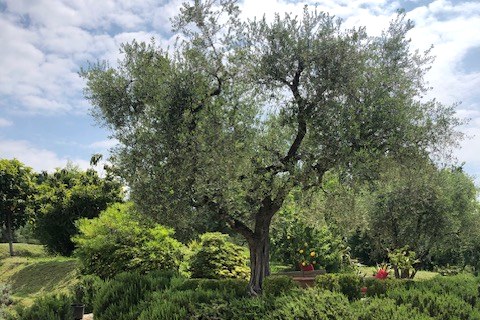
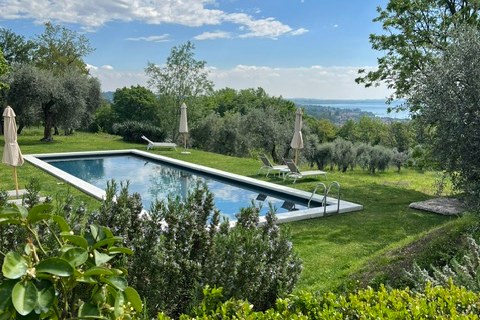
The garden continues into the countryside. Around the house there is a more formal area, which little by little blends into the meadows, olive groves and vineyards. Even the few plants we added belong to the local landscape and flora.
Discover the suites →Hospitality →
The present
The countryside, year after year
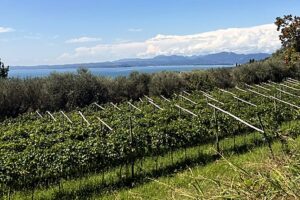
The restoration did not stop at the house. Every year the farm is looked after with clearing, pruning and maintenance; areas that had become overgrown and wooded have come back to life, and many centuries-old olive trees have been given back their shape. In 2020 we planted a small orchard of heritage fruit trees and replanted the first vineyard, which gives us the Ora rosé and the 2026 red; in 2022 the second, which gives us the Warda white and the sparkling rosé. Over the years the apiary, a small hen house and a small stable for the Ouessant sheep have also arrived.
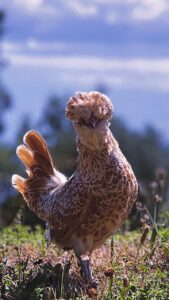
The Padovana is an ancient Italian breed of hen from the Padua area, recognisable by the large crest that covers its head.
Corvina, the main grape of our Ora rosé, is the signature variety of the Verona hills and the base of Chiaretto, the rosé of Lake Garda, a tradition born at the end of the nineteenth century.
The mountains to the north and the great body of water of the lake give Garda an almost Mediterranean climate: that is why the olive tree thrives so far north. Garda olive oil has been protected by a PDO since 1997.
The annex · 2025–2026
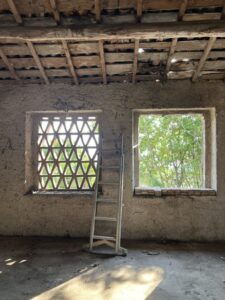
With the same approach, and again with the architect Zerman of Studio Athesis, the second house on the estate has been restored, now our annex: four rooms with a lake view, a five-minute walk from the main house.
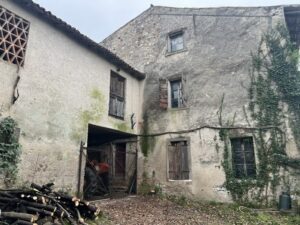
Before the works it was a typical farmhouse with a hayloft: stone and plaster walls worn by time, wooden shutters, brick grilles to air the hay and ivy covering the façade. As with Il Colombarone, the restoration has preserved its simple character and traditional materials.
The future
An oasis a stone’s throw from Bardolino
Just a short way from the busy centre of Bardolino, Prati Palai has remained an almost untouched oasis: buildings restored without losing their character and native nature, a real contribution to the Garda landscape and its biodiversity. Looking after it, and leaving it better than we received it, is our project for the years to come.
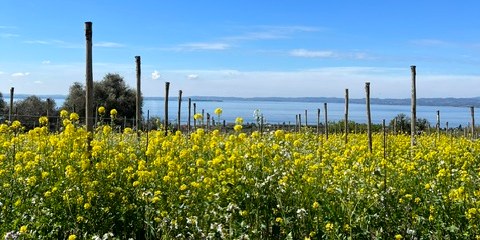
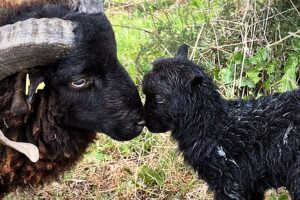
Besides the farm animals, it is not unusual to come across pheasants, hares, wood pigeons, sparrows, finches, ducks and birds of prey among the meadows and olive groves.
In the press
“In no contrast with the poetry of the historical background.”
— Forbes, 2020
“More like staying at someone’s private country estate.”
— Selected by RG
“Postcard perfect views across Lake Garda.”
— The Hotel Guru
Escape: Designing the Modern Guest House
— Qi Shanshan, The Images Publishing Group, 2016 · the restoration of Il Colombarone among 43 design guest houses selected worldwide
“Perché accontentarsi di una camera qualsiasi quando puoi essere il signore del lago?”
— The Good Life Italia, no. 8, May–June 2017
“This hotel feels like home, only prettier, and with a better pool.”
— Lodestars Anthology – Italy, 2016
“Return from a weekend rested and recharged.”
— ES Magazine, Evening Standard, 6 April 2018
“It’s a timeless place, but you really need to experience it to understand it.”
— Domenico Ferrari Barettoni, interviewed by the London Evening Standard, 2020
- The Telegraph
- Forbes – “Indelible Italy: Prati Palai on Lake Garda”, 2020
- Studio Athesis – the restoration project
- YouTrade – Stella taps at Prati Palai
- Divisare – atlas of contemporary architecture
- Archilovers
- Devon&Devon
- 84 Rooms – interview with Domenico Ferrari
- London Evening Standard – “Meet the hotelier behind Prati Palai on Lake Garda”, 2020
- Mr & Mrs Smith
- Käfer – Die Zeitung
- Pretty Hotels
- The Hotel Guru
- Selected by RG